I read Lissy's poem today......and that is L i s s y by the way! Sorry couldn't resist. The Hope poem very calming and so true. We need stuff like that in our lives.
Anyway, tutorial was good today, even though I felt like a stomach ulcer coming on with the stress. An incredibly stupid amount of work to produce in the next week or so, but felt good. Went home and have re assesst my planting plan and have now made the changes on paper. Just need to get the info on to my CAD drawing which shouldn't take too long as I am simplifying the annotation and hopefully it will read better.
I'll post the plan tomorrow and will photo and publish my two models which I told everyone I finished two weeks ago and still haven't put on the blog, so you'll get a glimpse of them too. Waiting for the little people in the post still.
I was singing my baby boy a song to calm him down tonight, but I think he has finally worked out that a rasp noise is funny .......so it didn't really calm him down. Here it is......
"There was a little fly
who flew into the grocers store.
He 'PHURT' on the ceiling
and he 'PHURT' on the floor.
He 'PHURT' on the bacon
and he 'PHURT on the ham.
And he 'PHURT on the head
of the little grocer man."
What a way to end the day.......and yes he did end the day with a 'PHURT'
Until tomorrow one and all.
Friday, 27 April 2012

Wednesday, 25 April 2012
Spray on Solar Cells
I came across this a week or two ago and have been meaning to put it on the blog. Has anyone else seen this. This could be the way forward, just think of the apllications we as designers could use this. No more ugly panels on rooves we could put the technology anywhere!

.
Spray-on solar may be future for green energy
As Japan seeks to optimize its use of environment-friendly energy sources in the wake of the nuclear crisis triggered by the March 11 earthquake and tsunami, a company here may just have come up with a major breakthrough: spray-on solar cells.
Mitsubishi Chemical Corp. has developed technology that enables solar cells to be applied to buildings, vehicles and even clothing in the same way that paint is applied. The breakthrough means that the places where energy from the sun can be harvested are almost limitless.

The new solar cells utilize carbon compounds which, when dried and solidified, act as semiconductors and generate electricity in reaction to being exposed to light. Most existing solar cell technology requires crystalline silicon to be sandwiched between glass sheets and positioned on the roofs of homes and office buildings, or in space-consuming "solar parks."
Scientists have been attempting to increase both the energy-gathering efficiency of solar panels and make them easier to install and use.
Mitsubishi Chemical is the first company to create prototype spray-on solar cells, which at present have a practical conversion level of 10.1 percent of light energy into electricity.
That figure is still some way behind the 20 percent that is standard in traditional crystalline silicon solar cells, but the firm expects to be able to improve the efficiency ratio to 15 percent by 2015 and is aiming to eventually reach 20 percent.
The company said the new painted-on solar cells would be particularly effective when applied to round or curved structures, such as chimneys or the noise-reduction barriers that line many highways in built-up areas of Japan.
It could also be applied to the exteriors of cars and theoretically used to help power the vehicle and even to such flexible surfaces as clothing.
It could also be applied to the exteriors of cars and theoretically used to help power the vehicle and even to such flexible surfaces as clothing.
The sprayed-on solar cells are less than 1 millimeter thick - far thinner than existing solar cell technology - and weigh less than one-tenth of crystalline solar panels of the same size, the company said.
Mitsubishi Chemical said it plans to work with domestic carmakers to build a car coated with the new solar cells with the aim of giving the vehicle sufficient power to travel 10 km after being exposed to sunlight for two hours.
The spray-on solar cells are a breakthrough concept, but other organizations are working on similar research to get the most out of energy from the sun. Scientists from The Australian Commonwealth Scientific and Research Organization, the University of Melbourne and the University of Padua in Italy are collaborating on 'printable laser' technology which could impose nano-particles onto wafer-thin panels which could then eventually be developed into into paper-thin solar panels.
.
Where do we go from here?
Well a new entry as promised. Wanted to talk about yesterdays crit. I am feeling a huge sense of indecision and confusion throughout the group. We seem to receive all the critique on what is missing, what is wrong and the why is that not there and the why is that there.......what about the, that bits working, I like that......well done?????
Even though I am behind myself , certainly in the rendered art work, I felt the work people pinned up in some cases was completely different from the previous crit. I think this is because everyones confidence is knocked a little and in doing so we leave one crit feeling that we are going in the wrong direction, so we are forced to try out something new. Then we go to the next crit and are asked why we have changed what we are doing. Unfortunately we don't have enough time to keep changing things and I am worried for myself and everyone else just how we are going to achieve our final work in time.
There is either far too much put into this third year or we simply are not taught enough in second year. No-one should be worried about rendering technique in the third year, we should be merely perfecting the skill. Afterall that is what the third year is all about in most degree courses. We are expected to know so much and to be quite honest if another person tells us there was a book in a reading list that we could have read to solve our problems, then why didn't I just do a blummin Home Learning Degree!
Anyway it's a bit late for this rant, both tonight and for the year, lets hope we all get through this thing with a little bit of confidence and dignity still remaining.
Even though I am behind myself , certainly in the rendered art work, I felt the work people pinned up in some cases was completely different from the previous crit. I think this is because everyones confidence is knocked a little and in doing so we leave one crit feeling that we are going in the wrong direction, so we are forced to try out something new. Then we go to the next crit and are asked why we have changed what we are doing. Unfortunately we don't have enough time to keep changing things and I am worried for myself and everyone else just how we are going to achieve our final work in time.
There is either far too much put into this third year or we simply are not taught enough in second year. No-one should be worried about rendering technique in the third year, we should be merely perfecting the skill. Afterall that is what the third year is all about in most degree courses. We are expected to know so much and to be quite honest if another person tells us there was a book in a reading list that we could have read to solve our problems, then why didn't I just do a blummin Home Learning Degree!
Anyway it's a bit late for this rant, both tonight and for the year, lets hope we all get through this thing with a little bit of confidence and dignity still remaining.
Monday, 23 April 2012
.......Hmmm, well my efforts of returning to regular blogging has completely failed. Sorry everyone.
Well done to everyone who pinned up today, I think we all have alot of work to do still, but we're heading in the right direction.
Anyway, across the next few days I hope to catch up. First off I'll just round off the trip to Lille I was talking about on my last blog. Don't worry, I'll make it short and sweet as everyone has read about this a mont ago on a number of other sites.
Initially we were put in small groups of about 5 people and were left to come up with a concept for the site. This concept was then to be presented the next morning to the whole group and lecturers. Assessments were made by the lecturers and then each group was twinned up with another. We then had the delightful job of amalgamating the two concepts into one. I actually thought this would be quite easy for some reason, but it became obvious very quickly that this task was going to be a challenge; not just for our group but for everyone! And here lies the main objectives of the course. Understanding, communication and comprimise.........
.....the first two fairly easy to grasp, but comprimise not so hot!!!
Anyway as this is a quick summary I will round up. The long and short of the story is that alot of people got stressed, alot of people hated what they were doing, but in the end we all made the important deadline (even if that ment working all the way through Thursday evenig!) and then eventually were very pleased with the results. A good experience and lessons learnt by all involved.
We had produced visuals and a 1:200 model and put together a presentation for local press and the Lille dignitaries. The off to the pub!!!!
Below are a couple of images at the presentation . I will blog again tomorrow.......no really I will!!


Well done to everyone who pinned up today, I think we all have alot of work to do still, but we're heading in the right direction.
Anyway, across the next few days I hope to catch up. First off I'll just round off the trip to Lille I was talking about on my last blog. Don't worry, I'll make it short and sweet as everyone has read about this a mont ago on a number of other sites.
Initially we were put in small groups of about 5 people and were left to come up with a concept for the site. This concept was then to be presented the next morning to the whole group and lecturers. Assessments were made by the lecturers and then each group was twinned up with another. We then had the delightful job of amalgamating the two concepts into one. I actually thought this would be quite easy for some reason, but it became obvious very quickly that this task was going to be a challenge; not just for our group but for everyone! And here lies the main objectives of the course. Understanding, communication and comprimise.........
.....the first two fairly easy to grasp, but comprimise not so hot!!!
Anyway as this is a quick summary I will round up. The long and short of the story is that alot of people got stressed, alot of people hated what they were doing, but in the end we all made the important deadline (even if that ment working all the way through Thursday evenig!) and then eventually were very pleased with the results. A good experience and lessons learnt by all involved.
We had produced visuals and a 1:200 model and put together a presentation for local press and the Lille dignitaries. The off to the pub!!!!
Below are a couple of images at the presentation . I will blog again tomorrow.......no really I will!!


Tuesday, 28 February 2012
Trip to Lille
Well it seems to have been a while since my last entry. Time has flown and alot has happened. But most significantly was our trip to Lille. So my first bit of catching up is about what I discovered on this trip and what I learned about myself and design. Working with a group of about 40 or so, half being the french students, we had been set the site of the Porte d'Pyres an area around the northern part of the city.

The brief was slightly daunting, but very exciting at this point. Although I have only just got to grips with the fact I am more of a landscape architect these days rather than a garden designer........but this....this was city planning! Road infrastructures, transport infrastructures commercial buildings, residential buildings, leisure facilities....oh and habitat! We were given an opening speach by ????????? who explained the history of the city, the difficulties with the site and how the collapsing industries over the years had left many parts of the city disjointed with residential and old commercial/industrial properties mixed together.
There were two things which on a larger scale to the site were significant charaters of the city. The first being the Citadel and old fortified ramparts and secondly the new 'Euro Lille'. The latter is the new ethos for the city to develop. Lilles location is perfect for a connection point of industry through Europe. The city planning has taken on the direction of basing the central station and Eurostar connections to be the heart of the city, rather than sticking the station to the city outskirts.
The historic side of things are the old ramparts. Some exposed some buried beneath the ground and covered up. Coinsiding with this are a number of waterways and canals, some of which linked with the old fortifications.
When we first arrived in Lille on the Sunday, we were greated first by frost, then by a snow blizzard....which I have to say gave a completely different view of the city. Below are some images of areas around the site we were about to work on.


The brief was slightly daunting, but very exciting at this point. Although I have only just got to grips with the fact I am more of a landscape architect these days rather than a garden designer........but this....this was city planning! Road infrastructures, transport infrastructures commercial buildings, residential buildings, leisure facilities....oh and habitat! We were given an opening speach by ????????? who explained the history of the city, the difficulties with the site and how the collapsing industries over the years had left many parts of the city disjointed with residential and old commercial/industrial properties mixed together.
There were two things which on a larger scale to the site were significant charaters of the city. The first being the Citadel and old fortified ramparts and secondly the new 'Euro Lille'. The latter is the new ethos for the city to develop. Lilles location is perfect for a connection point of industry through Europe. The city planning has taken on the direction of basing the central station and Eurostar connections to be the heart of the city, rather than sticking the station to the city outskirts.
The historic side of things are the old ramparts. Some exposed some buried beneath the ground and covered up. Coinsiding with this are a number of waterways and canals, some of which linked with the old fortifications.
When we first arrived in Lille on the Sunday, we were greated first by frost, then by a snow blizzard....which I have to say gave a completely different view of the city. Below are some images of areas around the site we were about to work on.

The frozen cannal which normally flowed into the south side of our site


Here an example of the stone and brick work in the city. Quite beautiful in places how the old and new mix. The old materials a mixture of Limestone which is indigenous to the area, along with brick work of which was a thriving industry in Lille. You can see in the bottom left picture an example of the hand made bricks held by Lime mortar. We later were shown an example of how the mortar can erode quite seriously over time. First it drys out, then the wind and rain get a hold of it and before you know the walls are crumbling away. Unfortunately I don't have a picture of this as the snow was preventing me from taking any pictures!!
TO BE CONTINUED TOMORROW........
Thursday, 26 January 2012
Wednesday, 25 January 2012
1:500 and sequential sketches
My 1:500 plan is a bit more updated, but still far from good enough. I have to admit I am struggling with this and yet it is not as if I don't know what I am doing isn't making the grade as it were. I look at my work and it lacks depth both in presentation and in detail. I also seem to have lost track of the fact I am ment to be designing planting! I have been looking at shapes, circulation, building function, how the wind will react to these elements and yet I've almost forgotten about the soft landscaping. I suppose this is where I feel I am studying landscape architecture and not garden design. I know, I know they are basically the same thing.
Andrew Wilson gave us a talk about starting a small business during our professional studies week. Someone asked him to define the difference between the two and his answer was this. It's about the client. Garden design is about designing for basically one person or a family, but essentially the client is who you are designing for. Landscape architecture is designing for a client on behalf of many others. You are designing public spaces and large facilities which essentially have to please a much broader 'clentelle'.
So I am side tracking again. My plan. I accept my annotation is pretty week at the moment and I should be going into alot more detail. In fact looking back at my 1:2000, I have shown more layers of thought here than in the 1:500! Blow....am I going backwards, I'm ment to be getting better at this. As my Saltwater Marsh Habitat is key to my design I have not really communicated more than this. This I fear needs to be addressed and fast. I need to show the planting for each level. It's essential a large pond by the sea, so why I have such a problem with this I do not know.
I'm not going to put the plan on the blog now as it is not important and looks very similar to how it was on my last post. I will however, get it up there very shortly when I get it finalised and looking like something I can be proud of.
The Sequential sketches are yet another stumbling block. Again, annotation is key and I have not put enough thought into what I am communicating. I don't think I have an issue with this, I just need to give myself some time and thought and get it on paper. The big issue is how I am visually communicating. My style is sloppy, the choice of media (dry pastel) is certainly not helping. It lacks punch and depth, having said that they did look better once I had shrunk them down and got them printed.


I think I should get myself I descent set of coloured pencils. What does everyone else think? Is this just too limited on detail and tonal quality.? I initially drew on A3 trace in pencil. I then traced the pencil work with black ink onto another set of trace. Then I rendered with dry pastels on a separate sheet of trace, placed the inked line work underneath and scanned through the two sheets. I felt this took the blacknes out of the line work, but in saying that I have no line hierachy. Is that where I am going wrong? This is so frustrating because there really isn't the time to be experimenting. I need a process that works and that I can achieve productively.
Bahhhhhhh!......Hopefully one of these blogs soon will read how happy I am with what I am doing and that 'it' has finally clicked. I have more luck learnig french......even though the 'click' hasn't happenened there either!
Andrew Wilson gave us a talk about starting a small business during our professional studies week. Someone asked him to define the difference between the two and his answer was this. It's about the client. Garden design is about designing for basically one person or a family, but essentially the client is who you are designing for. Landscape architecture is designing for a client on behalf of many others. You are designing public spaces and large facilities which essentially have to please a much broader 'clentelle'.
So I am side tracking again. My plan. I accept my annotation is pretty week at the moment and I should be going into alot more detail. In fact looking back at my 1:2000, I have shown more layers of thought here than in the 1:500! Blow....am I going backwards, I'm ment to be getting better at this. As my Saltwater Marsh Habitat is key to my design I have not really communicated more than this. This I fear needs to be addressed and fast. I need to show the planting for each level. It's essential a large pond by the sea, so why I have such a problem with this I do not know.
I'm not going to put the plan on the blog now as it is not important and looks very similar to how it was on my last post. I will however, get it up there very shortly when I get it finalised and looking like something I can be proud of.
The Sequential sketches are yet another stumbling block. Again, annotation is key and I have not put enough thought into what I am communicating. I don't think I have an issue with this, I just need to give myself some time and thought and get it on paper. The big issue is how I am visually communicating. My style is sloppy, the choice of media (dry pastel) is certainly not helping. It lacks punch and depth, having said that they did look better once I had shrunk them down and got them printed.

Looking from the harbour entrance towards Martello Tower
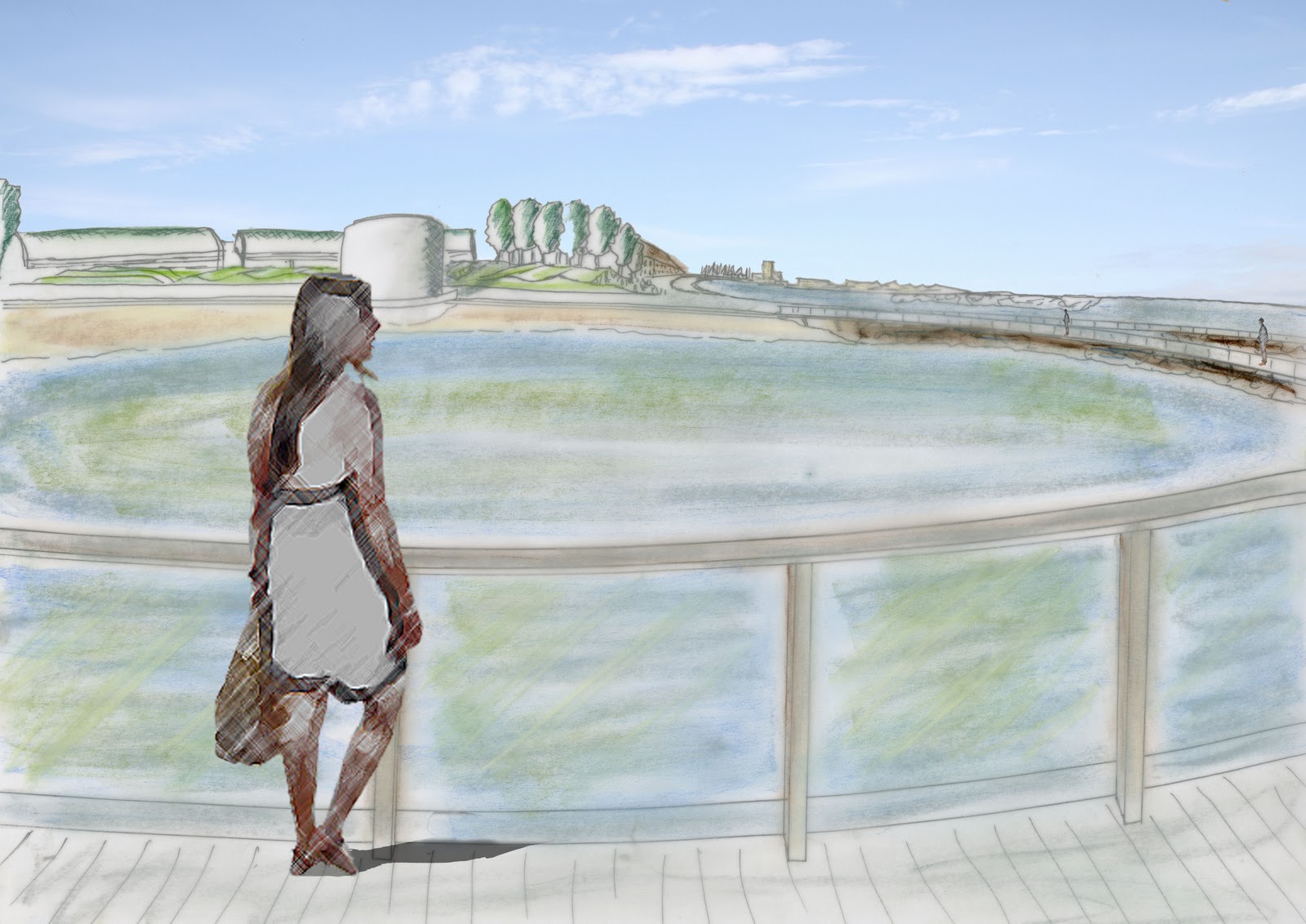
Looking from the boardwalk over the new saltwater marsh

Looking towards the eco build education centre through the wave landfroms

The promenade towards the harbour entrance

Connecting pathways of the main promenade, boardwalk and entarnce to education centre

The woodland shelter picnic area
I think I should get myself I descent set of coloured pencils. What does everyone else think? Is this just too limited on detail and tonal quality.? I initially drew on A3 trace in pencil. I then traced the pencil work with black ink onto another set of trace. Then I rendered with dry pastels on a separate sheet of trace, placed the inked line work underneath and scanned through the two sheets. I felt this took the blacknes out of the line work, but in saying that I have no line hierachy. Is that where I am going wrong? This is so frustrating because there really isn't the time to be experimenting. I need a process that works and that I can achieve productively.
Bahhhhhhh!......Hopefully one of these blogs soon will read how happy I am with what I am doing and that 'it' has finally clicked. I have more luck learnig french......even though the 'click' hasn't happenened there either!
Subscribe to:
Posts (Atom)